How To Get Better Sleep During Travel 2025

Traveling, whether for business or pleasure, is an important part of on-the-go lifestyles, but it can take its toll on your quality of rest—especially when your body has to adjust to a different time zone. Travel stress, skipped nighttime routines and dull hotel bedding can create a perfect storm, leading to restless nights spent watching the clock tick closer to morning. We’ve all been there. Below, I share my trusted sleep tips as a mattress and sleep editor who travels often and has tested top-rated accessories, along with science-backed recommendations from medical experts for better rest.
Traveling has a tendency to throw off our internal clocks, but our guide gives you science-backed tips on how to sleep better while on the road.
Illustration: Forbes / Photo: McKenzie Dillon for Forbes
“Your circadian rhythm—your biological timekeeper—is synced to light, meals, activity and routines,” says Joseph Dzierzewski, PhD, senior vice president of research and scientific affairs at the National Sleep Foundation. When traveling, especially crossing the continent or internationally, “the misalignment between local and home time can lead to sleep problems, daytime fatigue, irritability and other unwanted consequences,” he warns. Learning how to get better sleep while traveling is simple when you have the right gear, routines and accommodations, which prevent sleep deprivation from becoming a hindrance for work or leisure plans. Ahead, here are seven expert-backed tips that will help prevent poor rest from getting in the way of a full itinerary.

Tip 1: Pack A Sleep Mask
Want to save this story for later?
No need to bookmark—get it straight to your inbox.
We’ve sent this story to your inbox.
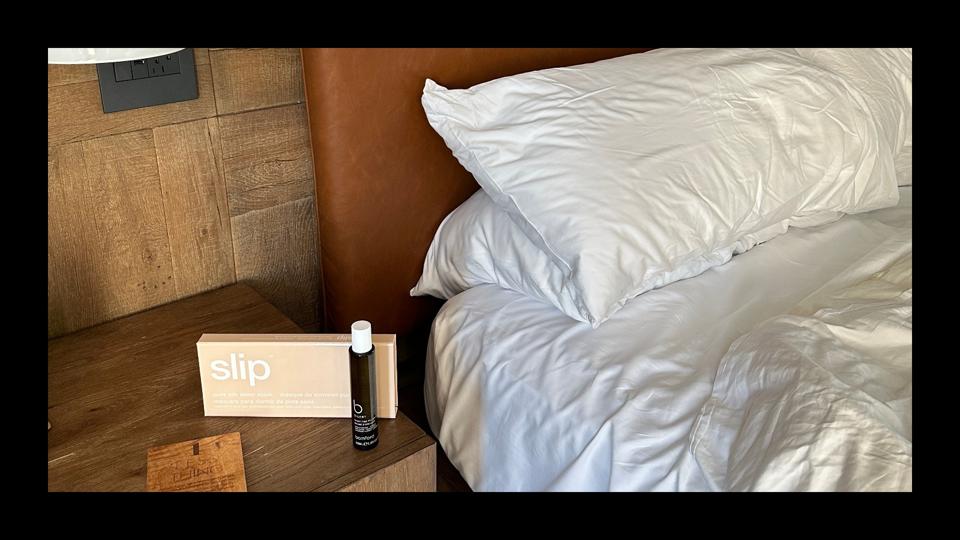
Generally, a person’s internal clock responds to darkness by signaling that bedtime is near and triggering the natural release of melatonin. Light, on the other hand, has an opposite effect, causing travelers and hotel-dwellers to feel more alert. Dzierzewski says, “Darkness is an important component of a sleep-friendly space, and sleep masks are a nice way to create a dark sleep space almost anywhere.”
Dzierzewski warns that curtains and blinds alone may not be enough to block light, as even the subtle glow of a streetlamp can interfere with your circadian rhythm. By wearing a sleep mask to bed, you prevent light sources, including electronic and ambient light, from disrupting your slow-wave sleep (deep sleep). Plus, their ultra-compact design makes them easy to slip into a bag or suitcase.
The Therabody Sleep Mask is my favorite sleep and travel accessory and accompanies me often when I travel. The eye sockets are cupped and cushioned for extra comfort, and it’s designed with a built-in massager that automatically turns off after around 20 minutes—well after I’m typically asleep.
I always pack my Therabody Sleep Mask when I travel.
McKenzie Dillon for Forbes
Tip 2: Don’t Always Rely On Hotel Bedding
It may sound unconventional, but bringing along a reliable compact pillow can help you bring the comfort of home wherever you travel, and avoid the restlessness that comes with constantly re-fluffing your hotel pillow throughout the night. More often than not, pillows found in hotels can lack the proper support to maintain your spine’s natural curvature, leading to poor rest and aches and pains come morning. Bringing your own pillow for vacations or business trips can make unfamiliar places feel more comfortable and help sleep come more easily.
The Purple Harmony Anywhere Pillow combines supportive materials like Talalay latex and Purple’s proprietary GelFlex Grid—a stretchy and responsive layer—to help align your spine and enhance the feel of lackluster hotel bedding. It’s smaller than a standard pillow, measuring 16 x 13 x 6 inches and weighing 3.6 pounds, but its impact on structure and comfort is significant. Its travel case (sold separately) compresses the pillow and features a clip along with a convenient sleeve that slides seamlessly over your carry-on handle.
My Purple Anywhere Travel Pillow helps enhance any hotel bed.
McKenzie Dillon for Forbes
Tip 3: Block Out Unwanted Noise
Noise levels can be unpredictable while traveling, whether you’re airborne or settling into a hotel room. The Soundcore Sleep A30 Earbuds not only fit comfortably in your ears thanks to their soft, cushy exterior, but they also feature thoughtful extras like a snore-masking system that emits targeted audio to counter snoring in real time, along with optional foam tips for maximum noise reduction.
At bedtime, you can customize your own experience by blending relaxing sounds from the Soundcore app library, or enjoy a curated sleep playlist to help you unwind. As an alternative, consider one of the best earplugs—squishy foam or soft silicone inserts that fit snugly in your ear canal to help create a quieter environment.
Tip 4: Sync Your Meals To Local Time
Another expert-backed tip for better sleep while traveling: Align your meals with your destination’s time zone. “Meal timing acts as a powerful, external cue that helps synchronize your internal clock to a new time zone,” says Dzierzewski, “reinforcing your day and night cycle.” This may require eating when you don’t physically feel hungry, but having breakfast, lunch and dinner in accordance with local time benefits your entire body, “giving your organs and intestines the proper time to adjust to your new meal routine,” according to Dr. Emma Lin, co-founder and sleep medicine physician at ReadyO2. Some research suggests that eating a substantial breakfast during travel can be effective in combatting jet lag symptoms like fatigue, irritability and low energy. Dzierzewski adds, “syncing your fork with your flight path is a science-backed and effective way to help your body recalibrate to a new time zone.”
During a recent trip, I scheduled a morning breakfast basket to start the day with a hearty meal.
McKenzie Dillon for Forbes
Tip 5: Maintain A Bedtime Routine
Traveling can offset your regular routine and sleep schedule, especially if you cross time zones. Similar to the darkness, “Your bedtime routine is like a cue to your body that tells it that it is time to sleep,” says Lin. Even when you are traveling, “a bedtime routine ensures that your body clock is in sync.” For a bedtime routine that works anywhere, she suggests practices like gentle stretches, deep breathing exercises and spraying a calming scent—all of which, she says, help lower heart rate and relax the lungs.
Tip 6: Wind Down With 5 Minutes Of Writing
Pack a journal in your carry-on, weekender or suitcase to revisit during your bedtime routine. Studies have shown that journaling for just five minutes before bed can help reduce sleep latency, the amount of time it takes to drift asleep, but being intentional about your writing is key. In a 2018 multi-night sleep study, participants who journaled a detailed to-do list for the following day fell asleep significantly faster than those who wrote about completed tasks—likely because the practice reduces bedtime stress, a major inhibitor of quality rest.
Tip 7: Use Aromatherapy To Help Lull You To Sleep
Research suggests that aromatherapy, particularly scents like lavender and chamomile, can reduce stress, ease pain and slow your heart rate before bed, all of which may improve sleep quality. Spritzing a mist on your pillow and linens helps create a calming sleep environment with spa-like undertones, no matter where you are. I was recently introduced to a lavender pillow mist that has now become a bedtime favorite, whether I’m at home or traveling.
Why Trust Forbes Vetted
Our experienced writers and editors consult with experts and research top-rated products to deliver trusted sleep advice that helps you get closer to better rest. Our team has thoroughly tested and covered all topics across the sleep category, including mattresses, pillows and adjustable bed frames.
- McKenzie Dillon is a mattress and sleep editor with six years of testing and writing experience, focused on the best and most innovative products on the market. She travels at least once a month for business or pleasure and always prioritizes sleep while on the road. In addition to booking accommodations with the best sleep amenities, she also brings along her favorite tested products to make deep sleep more achievable.
- Bridget Chapman, with over a decade of reporting and editing experience, oversees the sleep category at Forbes Vetted as the senior mattress and sleep editor. In addition to earning her sleep science coach certification, she has tested a myriad of products in the sleep industry, including sleep masks, bedding and travel pillows.
- To gain deeper insight into how travel affects sleep and tips for improving rest, we spoke with Joseph Dzierzewski, PhD, senior vice president of research and scientific affairs at the National Sleep Foundation, and Dr. Emma Lin, co-founder and sleep medicine physician at ReadyO2.
link